Jason | April 9th, Moved into the Apartment
Today I finally moved into a single room in a rented apartment, so I no longer have to carry my luggage to class. More
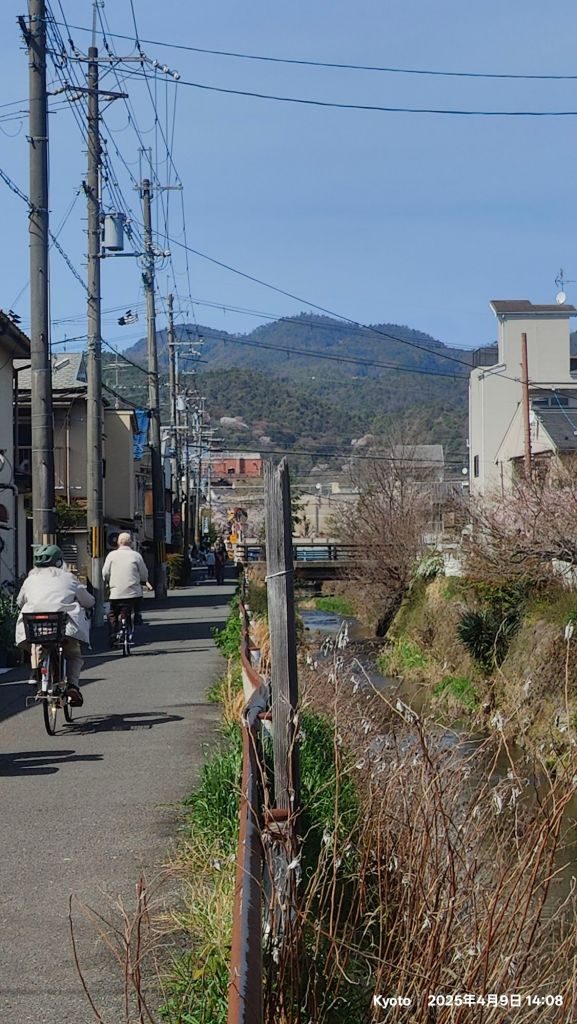
Today I finally moved into a single room in a rented apartment, so I no longer have to carry my luggage to class.
The apartment is in a village at the foot of Arashiyama in northwestern Kyoto, next to a railway line and a stream. Actually, it's not far from the city center — about 6 kilometers, roughly the distance from the old city to Wuwei Temple. This is my first time here. As I approached, I rode along the stream with cherry blossoms on both sides and mountains not far ahead. I could hardly believe it — it's too good. I had thought it would be just an ordinary city apartment by the roadside.
When I arrived, I felt this area was more like a small village. Each type of shop probably has only one. There aren't many people on the streets, and the pace is slow. It suits me perfectly.
I got this apartment through a British classmate. After the orientation, I went to the rooftop for a smoke and met him. He knew I was staying at an internet cafe and told me about a share house website where he lived. I checked and found several apartments. Only one was vacant: Unit 25, Room 104. I booked it immediately.
At 1:00 PM, Airi from the rental company came over to check me in. She explained everything in detail, including common area usage, kitchen, appliances, shower, washing machine, dryer, house rules, garbage sorting, lease renewal, and payment. She was very thorough. Rent is 2500 per month, management fee is a one-time 750 yuan, and cleaning fee is a one-time 500 yuan.
Interestingly, before this apartment was taken over by Kyoto Apartment, it was the dormitory of my language school, ISI.
["Image data omitted for brevity in JSON, but should be kept as is in real output because it's part of content."]
After settling in, I went outside for a smoke. Just then, someone came out and greeted me warmly, then stopped to chat. He introduced himself as Trevor, an Australian. He bought a house nearby and is planning to renovate it. He's staying temporarily in this apartment for a month and moved in three days ago. He runs a small digital marketing company, works remotely, and plans to travel around and stay in different places. Previously, he lived in Vietnam for half a year. I told him I'm from Yunnan, China, and he got excited, saying his uncle's wife is from Yunnan. He showed me on a map — she's from Lijiang.
We chatted for about twenty minutes, then he went out to buy groceries.
I rode my bike toward the mountains, hoping to find a spot to hike. Soon I arrived at the foot of Arashiyama, crossing the Katsura River. There were many tourists there, but I could tell that if I came in the evening or at night, when the crowds leave, walking along the wide Katsura River would be extraordinarily beautiful. The stream murmurs, and cherry trees line both banks. Whether in blossom season or not, it's equally nice.
I continued deeper along the Katsura River. The road narrowed along the mountain and river, and further in, there were no people. On the opposite bank, there was no road, just cherry blossoms on the hillside. There was also a river beach with wide, clear green water. Nearby, there was a temple that had already closed.
["Image data omitted"]
Unable to go further, I turned back. I could return along the Katsura River — it's less than a kilometer from my place, so I can walk here in the future.
["Image data omitted"]
I went into a supermarket and bought a box of strawberries, 20 yuan. Thinking I could cook in the future, I checked out seasonings and rice: about 100 yuan for 4 jin of rice, a small bucket of soy sauce for about 25 yuan, and five or six small chili peppers for 9 yuan.
["Image data omitted"]
After getting an idea of the prices, I continued back. I passed a coffee shop and went in. The owner, not surprisingly, was an elderly lady. She only spoke Japanese, and the menu was in Japanese. As usual, I ordered coffee and an egg sandwich, 750 yen (38 yuan). The egg sandwich also had mustard flavor — seems to be the traditional way — and it was delicious. There were two other tables: two elderly women and one middle-aged woman, who had a cigarette.
["Image data omitted"]
Back at the apartment, I talked with Yuwei from September about how to post event info on our website. She mentioned that Zhou Yunpeng is also in Kyoto. To get permanent residency, he needs to stay half a year each year. In a foreign land, that seemed like a reason to meet. I didn't know Zhou Yunpeng personally, though I had seen him and we both lived in Dali for many years. So she acted as a go-between, and we arranged to have dinner together the day after tomorrow. If possible, we could spend more time together.
I sat in the apartment kitchen for a while. Trevor also came back and was preparing a meal, probably sandwiches. He said he wanted to make a batch and put them in the fridge.
As we were talking, another young guy joined. His name is Yoshi, and he is Japanese.
I asked him, "What do you do? Study or work?"
"Work. I work at a lacquerware workshop." (I had to check a translation app to understand lacquerware)
"What did you do before?"
"I graduated from university, studied biology, mainly environmental science."
"Quite a difference."
"Yeah. After graduation, I had a strong feeling that I wanted to make lacquerware, so I found this workshop as an apprentice."
Yoshi is from Niigata, in the northern part of Honshu. I asked how far it was. He said, "Even the Shinkansen takes a few hours."
We spoke in English. His English isn't very good, and my Japanese is nonexistent. We used Google Translate several times.
Then Trevor joined in. I asked him how his uncle and aunt met. He said, "My uncle taught English in China. He met her in Lijiang. But my aunt couldn't speak a word of English."
"When I was a kid, I loved going to my uncle's house because my aunt's cooking was so good. Even though she couldn't speak English, I really liked her. She didn't know English and had no friends."
"My mom's side of the family was rude, saying she couldn't speak the language and was probably useless. But later, she opened a super successful Chinese restaurant. She did better than everyone, and her English became really good."
"But in recent years, she says she wants to go home. She doesn't like Australia. Every time she goes back to China and hangs out with friends, she's very happy and doesn't want to return to Australia. I understand her."
I'm really glad I moved into this apartment. Everyone is willing to talk, friendly, and interesting.
Photos and videos
계속 읽기
3
Jason | Using AI to Create Your Own Mini Program/Website
Two months ago in Chiang Mai, I stumbled upon the chance to start learning how to build mini programs. My AI programming mentor, Wangshen, told me, 'Once you finish your mini program, write a summary report.' Now I've completed the new mini program for Cangshan Hiking Home, and it's already being tested. It not only solves problems I've wanted to address for a while, like adding age tags to filter activities and providing an English version, but it has also introduced new features, such as browsing restaurants, guesthouses, and meeting points on a map for a more intuitive experience, and using AI to provide quite intelligent responses.
Learn AI Programming Together
Some information about AI programming
Celebrate the Torch Festival in a Nanzhao Royal Clan Village
Over the past two years, we have taken guests to celebrate the Torch Festival in Songhe Village, Eryuan. Together we slaughtered a sheep, and with the whole village, erected a huge torch in the center of the village square. Everyone made their own torches from hemp stalks, and together with the older and younger villagers, we rushed to grab the blessing baba (cakes) from the big torch, passing blessings to each other with fire. Even for me, a native Bai person, these are rare and precious traditional festival experiences. Dali has endless festivals, and I want to experience them more before they fade away. I remember the Torch Festival of my childhood: torches were no longer enough for me. Before the festival, I would tell my dad to prepare a bucket of waste engine oil and diesel, mix them together, and then I would tightly bind cotton and old cloth with rope into a ball (some kids would secretly take cotton from their quilts at home to make it). Finally, I would make an iron wire ball, soak it in the bucket of oil, and secretly take it out every day to look at it, looking forward to having a great time on the day of the Torch Festival. We would compete in the village and by the rice fields to see whose fireball or torch was more impressive. When the torches and fireballs were almost burned out, we would rush home, walk around the potted fruit trees in circles, and say blessing words, hoping they would grow even better in the coming year.