Weeds Scene | Diary of Being with You in Chiang Dao
Looking closely, you don't actually need to express yourself; people can still live ordinary, matter-of-fact lives. Yet, despite this, you still hope to express something. In this 'nevertheless' natural context, we might unexpectedly see our true selves.
Going to Chiang Dao, we sat on a bench outside the station convenience store and ate heated pad krapow. While chatting, You talked about her solo hike to Haba Snow Mountain and how she nearly got buried in the snow.
I: 'When I was little, I was quite timid and afraid to do many things alone.'
You: 'Because my sister was brave, she took me everywhere. We spent the whole summer searching for cicada shells in hard-to-reach places.'
During the two days we spent together, You mentioned her sister many times.
It reminded me that when I was young, I also had a favorite older sister. Like You, I was obedient as a child, hiding in corners and never talking back. That sister was formidable, bold, and even smoked. When we grew up, we switched roles. In the eyes of adults, I became rebellious and lived a ridiculous life, while my sister followed the routine, got married, had children, and satisfied everyone.
But You still have a close connection with your sister, while I don't. Sometimes, I lack some ability.
This time to Chiang Dao, we took a bus, slightly bigger than last time's, but still without air conditioning.
I sat by the window, a quarter of which was open. As the bus moved, the wind blowing in hit my short hair ends hard, still carrying warmth. When I reached out to comb through them, they were already stiffly tangled.
The small blue-bladed fan overhead was oscillating industriously, making a buzzing nostalgic sound. It reminded me of a summer when I lay on the floor at my uncle's house. When no one spoke, the fan's buzzing became clear.
I prepared to close my eyes and rest. I wondered if, like last time, a wind with a fresh green scent would blow in.
When we arrived in Chiang Dao, Fan had already been playing in Xiangbala for three days. From the photos she sent, I saw her tent set up in a haystack that cows visited. Following the clues, we easily found her tent but didn't see her. Nearby was a path leading up a slope. You and I exchanged glances and decided to walk up and check.
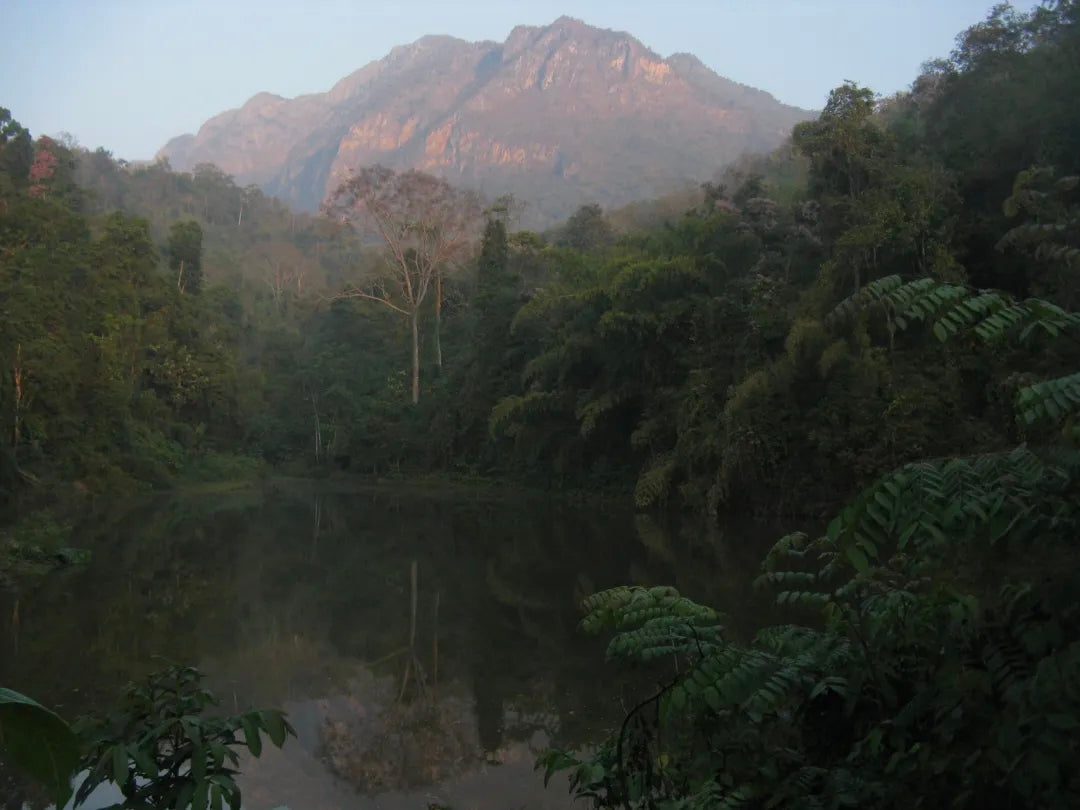
Unexpectedly, after a five-minute climb, a lake appeared before us. There was no one around. The lake was surrounded by large trees and various plants, peaceful, as if holding sacred water. In the bamboo grove across, clusters of pink-purple flowers were blooming. I thought this was an ideal camping spot. On the way here, we passed by the camping area cordoned off by Xiangbala, with tents densely packed and many people—a different world from here.
There were traces of a fire on the ground. We used the leftover straw from the fire starters as padding under our tent, making it softer to sleep on. By the time we set up the tent, Fan walked over from across the lake—she had been hiking in the woods. She was surprised we found this place.
We changed into swimsuits, planning to bathe in the stream near the hot spring while there was still sunlight. In Chiang Dao, after sunset, the temperature drops, and it no longer feels like the tropics.
On the way to the stream, Fan pulled out a special cake she bought in Chiang Rai from her crossbody bag; half of it was left. I had never eaten a special cake and was curious, so I took a spoonful, and You also took one.
The water in the stream was shallow, only covering my ankles. Fan, wearing a long pencil skirt, just sat on the grassy bank sunbathing. You and I tried to submerge our whole bodies in the water, so we lay straight and slowly let the fresh skin touch the stream. Though the sun was still out, the water wasn't warm, so we had to ease in bit by bit. You could also plunge in all at once, but I couldn't. Sometimes you need that kind of courage—once all the new skin has touched the stream water, you no longer feel cold.
When we returned to the grassy bank and sat with Fan, I started laughing uncontrollably. Seeing me laugh, You began chuckling too. I knew we had entered another world.
At some point, my hand was already in Yours. As we walked hand in hand up the slope to the tent, she said, 'I feel like the whole world around me is magnified. When I touch my skin, it feels like velvet.'
'Do you think when we wake up later, we'll still remember this feeling?' You's tone and voice had also changed.
'Otherwise, I'll start recording from now. That way, we'll know,' I said.
My rationality was still firm; I knew I was in another world, and I knew what to do and what not to do.
At that moment, the allure of music was also magnified. It drew me like a magnet, and so we followed that magnet to the stage where music was playing. A day earlier, I couldn't have imagined the serious You dancing in a crowd. But now, she was swaying her fingers in front of me and occasionally poking my arm.
In the music, closing your eyes allowed you to enter an even more absorbing world. In the moments we opened our eyes, we tried to regain rationality.
'I feel like I'm not afraid to make eye contact anymore. I'm not afraid of others seeing me,' I said when we left the music.
'Me too. If only I could not be socially anxious in the real world,' You said.
We had truly experienced a completely different version of ourselves.
I went to buy food and told You to wait on a bamboo bench under a tree. Instead of sitting, You lay down flat on it, took off her glasses, and pointed at something nearby: 'The world has shrunk! So the world I usually see is different from what you all see. But now, I can make it big or small as I want.'
Then she pulled out her phone and video-called a friend.
'I... I really like you, really like you, really like you, you know!' were the first words You said to the person on the other end.
Standing by, already two-thirds back in the real world, I was stunned. You's friend was probably stunned too. But later she told me that the person who answered was indeed her very good friend, like family. Hmm, such confessions between close friends—I think it's nice. In the real world, it's hard to be so straightforward.
'Do you still want to dance?' You, still in the other world, asked me after eating.
'I don't want to,' I answered from the real world.
'I just thought seriously, I think I kind of miss that light feeling after smoking a cigarette in the real world. The complete other world feels too heavy for me. I still want to be able to be clear-headed in my own world,' I summarized the feeling I shared with You.
'Hmm...' You was pulled back to reality by my answer, no longer smiling.
'I don't want to either. In the other world, you don't need to do anything; you just do whatever you want. But there's a sense of endlessness. Time stops here, and you stay here, like an outsider. I don't want to keep drifting on the sidelines, only watching others truly live. But you can only keep walking, walking, walking, because you have no control over doing things. What you had a second ago is gone the next, and time just freezes.' As she said this, You's eyes changed.
The next day, You woke up early; I woke up at 9. We then walked into the forest across the lake together. After descending, we went back to the stream and submerged our entire bodies in the water. In the evening, we listened to music and danced together. After experiencing the other world, we returned to the real world and repeated the experience.
I asked You: 'If you really had the chance to choose to become an extrovert from now on, would you choose it?'
'I wouldn't,' You replied.
The people walking in Xiangbala, to varying degrees, probably have some desire to express themselves or be different from others. At first glance, You and I looked like the most ordinary and honest among them.
I remembered a passage I read a few days ago by Haruki Murakami: If you stare intently at 'what you are pursuing' and keep fixating on it, the story inevitably becomes heavy. And in many cases, the heavier the story, the farther freedom hides. In contrast, the 'self that does not pursue anything' is as light as a butterfly, free and unrestrained.
Looking closely, you don't actually need to express yourself; people can still live ordinary, matter-of-fact lives. Yet, despite this, you still hope to express something. In this 'nevertheless' natural context, we might unexpectedly see our true selves.
계속 읽기
3
Jason | Using AI to Create Your Own Mini Program/Website
Two months ago in Chiang Mai, I stumbled upon the chance to start learning how to build mini programs. My AI programming mentor, Wangshen, told me, 'Once you finish your mini program, write a summary report.' Now I've completed the new mini program for Cangshan Hiking Home, and it's already being tested. It not only solves problems I've wanted to address for a while, like adding age tags to filter activities and providing an English version, but it has also introduced new features, such as browsing restaurants, guesthouses, and meeting points on a map for a more intuitive experience, and using AI to provide quite intelligent responses.
Learn AI Programming Together
Some information about AI programming
Celebrate the Torch Festival in a Nanzhao Royal Clan Village
Over the past two years, we have taken guests to celebrate the Torch Festival in Songhe Village, Eryuan. Together we slaughtered a sheep, and with the whole village, erected a huge torch in the center of the village square. Everyone made their own torches from hemp stalks, and together with the older and younger villagers, we rushed to grab the blessing baba (cakes) from the big torch, passing blessings to each other with fire. Even for me, a native Bai person, these are rare and precious traditional festival experiences. Dali has endless festivals, and I want to experience them more before they fade away. I remember the Torch Festival of my childhood: torches were no longer enough for me. Before the festival, I would tell my dad to prepare a bucket of waste engine oil and diesel, mix them together, and then I would tightly bind cotton and old cloth with rope into a ball (some kids would secretly take cotton from their quilts at home to make it). Finally, I would make an iron wire ball, soak it in the bucket of oil, and secretly take it out every day to look at it, looking forward to having a great time on the day of the Torch Festival. We would compete in the village and by the rice fields to see whose fireball or torch was more impressive. When the torches and fireballs were almost burned out, we would rush home, walk around the potted fruit trees in circles, and say blessing words, hoping they would grow even better in the coming year.